
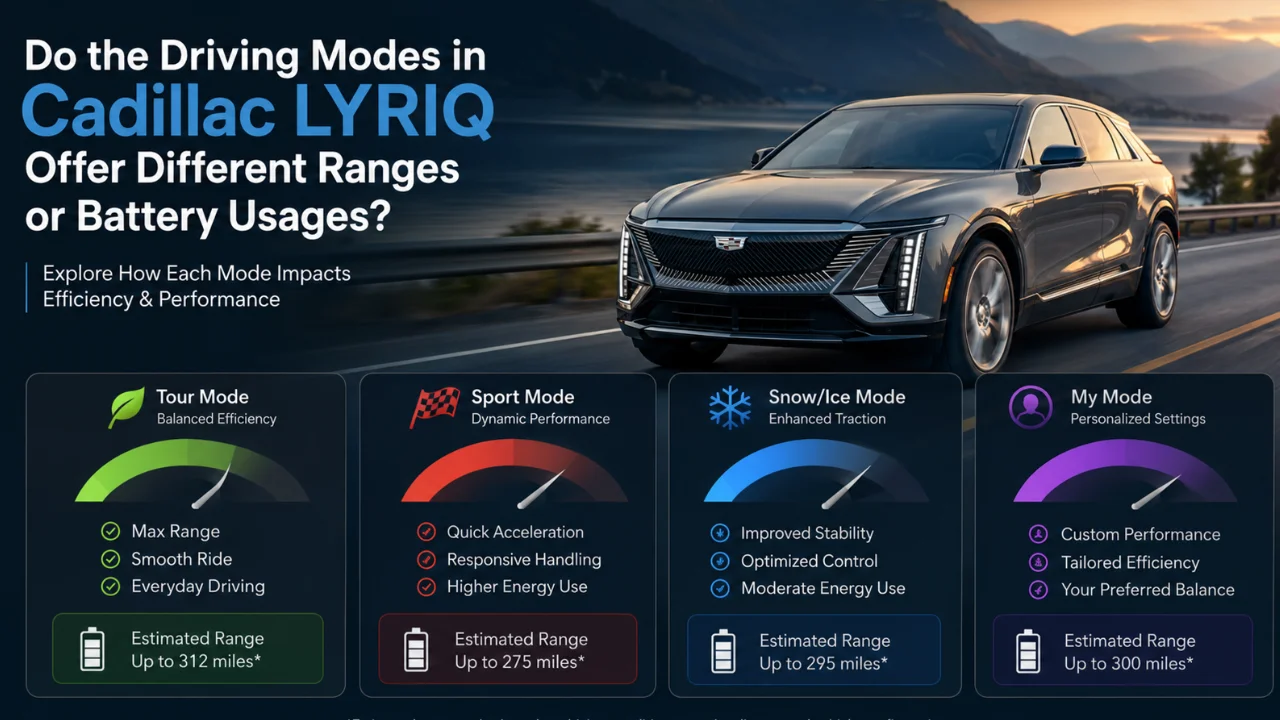
Electric vehicles like the Cadillac LYRIQ are designed with multiple driving modes to adjust performance, comfort, and energy efficiency. Many drivers in the UAE ask a simple question: do these driving modes actually change the range or battery usage, or do they only change how the car feels?
- Understanding the Cadillac LYRIQ Electric Powertrain and Battery System
- Dual-motor vs single-motor configurations (RWD vs AWD impact)
- Built-in efficiency systems and thermal management
- What Driving Modes Mean in the Cadillac LYRIQ
- Complete Breakdown of Cadillac LYRIQ Driving Modes
- Tour Mode – Balanced Efficiency and Comfort (Default Range Optimisation Mode)
- Sport Mode – Performance-Oriented Driving with Higher Energy Usage
- Snow / Ice Mode – Maximum Stability in Low-Traction Conditions
- My Mode – Customised Balance Between Performance and Efficiency
- Performance-Focused Mode Variants (Where Available in Higher Trims)
- How each mode adapts power delivery and driving behaviour
- How Driving Modes Affect Range and Battery Consumption
- Do driving modes change actual battery capacity? (Clear explanation)
- Energy usage differences between modes in real conditions
- Throttle sensitivity and acceleration impact on consumption
- Regenerative braking strength variations across modes
- HVAC load interaction with driving modes
- Efficiency trade-offs between comfort, safety, and performance
- Real-World Range Comparison Across Driving Modes
- Regenerative Braking and One-Pedal Driving in the LYRIQ
- Factors Beyond Driving Modes That Affect Battery Range
- Driving speed and highway cruising impact
- Aggressive acceleration and braking patterns
- Climate control usage (heating and air conditioning load)
- Battery thermal management and external temperature effects
- Vehicle load, passengers, and cargo weight
- Tyre condition and road surface quality
- Charging habits and battery health over time
- Practical Tips to Maximise Cadillac LYRIQ Driving Range
- Common Mistakes That Reduce EV Range
- Which Driving Mode Should You Use and When
- FAQs
- Do driving modes in the Cadillac LYRIQ change actual range or just behaviour?
- Which mode offers the best battery efficiency for daily driving?
- Does Sport Mode significantly reduce driving range?
- Can My Mode improve efficiency beyond default settings?
- Does Snow/Ice Mode increase battery consumption?
- How does air conditioning affect range in UAE weather conditions?
- Is one-pedal driving available in all driving modes?
- What is the real-world range difference between city and highway driving?
- Does frequent mode switching affect battery health?
- What is the official estimated driving range under optimal conditions?
The short answer is yes, driving modes can influence real-world range, but they do not change the battery capacity itself. Instead, they adjust how energy is used, how power is delivered, and how efficiently the vehicle behaves in different conditions.
This guide explains everything in simple terms, with UAE driving conditions in mind, including hot weather, long highways, and city congestion.
Understanding the Cadillac LYRIQ Electric Powertrain and Battery System
The Cadillac LYRIQ is built on a modern electric platform designed to balance performance and efficiency. Its range depends on how energy is stored, managed, and used during driving.
Dual-motor vs single-motor configurations (RWD vs AWD impact)
The LYRIQ is available in different drivetrain setups, which directly affect efficiency:
- Rear-wheel drive (single motor): Generally offers better range due to lower energy demand
- All-wheel drive (dual motor): Provides better traction but uses more energy
In UAE highway driving, RWD versions typically achieve slightly longer real-world range, especially during steady-speed cruising.
Also Read: 10 Essential Things To Do In Dubai!
Built-in efficiency systems and thermal management
The LYRIQ uses advanced thermal systems to maintain battery temperature, which is important in the UAE’s hot climate.
Key systems include:
- Battery cooling and heating control
- Energy distribution optimisation
- Real-time power management
- Heat protection during fast charging and long drives
These systems ensure the battery performs consistently even in extreme summer temperatures.
What Driving Modes Mean in the Cadillac LYRIQ
Driving modes are preset configurations that change how the vehicle behaves based on your driving needs.
Purpose of driving modes in modern electric SUVs
Driving modes are designed to help drivers:
- Improve comfort during daily driving
- Increase efficiency for longer range
- Enhance stability in difficult road conditions
- Deliver performance when needed
In simple terms, they help balance power use depending on the situation.
Key vehicle adjustments influenced by modes
Each driving mode changes multiple systems at once:
- Throttle response (how quickly the car accelerates)
- Steering feel (light or firm handling)
- Power output distribution (balanced or aggressive delivery)
- Traction and stability control sensitivity
- Regenerative braking strength
- Climate system energy consumption
These small changes collectively influence how much battery is used over time.
Complete Breakdown of Cadillac LYRIQ Driving Modes
The Cadillac LYRIQ offers multiple driving modes designed for different road conditions and driving preferences.
Tour Mode – Balanced Efficiency and Comfort (Default Range Optimisation Mode)
Tour mode is the standard driving setting used for daily commuting.
It offers:
- Smooth acceleration
- Balanced energy consumption
- Comfortable steering response
- Optimised range performance
This is the most efficient mode for city driving in Dubai or Abu Dhabi.
Sport Mode – Performance-Oriented Driving with Higher Energy Usage
Sport mode prioritises performance over efficiency.
It provides:
- Faster throttle response
- Stronger acceleration
- Heavier steering feel
- Reduced efficiency and lower range
In UAE conditions, frequent use of Sport mode can noticeably reduce range, especially in traffic.
Snow / Ice Mode – Maximum Stability in Low-Traction Conditions
Although not frequently used in the UAE, this mode is useful during rare rainy or sandy conditions.
It focuses on:
- Reduced wheel spin
- Softer acceleration
- Maximum traction control
- Safer handling on slippery roads
Energy use may increase slightly due to stability systems working more actively.
My Mode – Customised Balance Between Performance and Efficiency
My Mode allows drivers to personalise settings.
You can adjust:
- Steering weight
- Acceleration response
- Regenerative braking level
- Comfort vs performance balance
This mode is useful for UAE drivers who want a mix of efficiency and comfort depending on daily routes.
Performance-Focused Mode Variants (Where Available in Higher Trims)
Some higher trims may include enhanced performance settings.
These modes:
- Increase power output
- Reduce efficiency for maximum acceleration
- Prioritise dynamic driving experience
They are best used occasionally rather than for daily commuting.
How each mode adapts power delivery and driving behaviour
All driving modes work by adjusting:
- Energy distribution between motors
- Acceleration sensitivity
- Brake energy recovery
- Stability control thresholds
This is why range changes even though battery size remains the same.
How Driving Modes Affect Range and Battery Consumption
Different driving modes change how the LYRIQ delivers power, responds to acceleration, and manages energy usage.
While these modes do not alter the battery’s actual capacity, they can impact real-world range by influencing efficiency, performance, regenerative braking behaviour, and overall power consumption.
Also Read: Sonapur Dubai Area Guide: Location, Labour Accommodation & Lifestyle!
Do driving modes change actual battery capacity? (Clear explanation)
No, driving modes do not change the battery capacity.
They only influence:
- How quickly energy is used
- How efficiently energy is recovered
- Driver behaviour response
Think of modes as “energy settings,” not battery changes.
Energy usage differences between modes in real conditions
Typical pattern:
- Tour Mode → Best range
- My Mode → Variable
- Snow/Ice Mode → Moderate efficiency
- Sport Mode → Lowest range
Throttle sensitivity and acceleration impact on consumption
Faster acceleration requires more energy. Sport mode increases throttle sensitivity, which naturally leads to higher battery consumption.
Regenerative braking strength variations across modes
Regenerative braking helps recover energy when slowing down.
- Stronger regen = better efficiency
- Weaker regen = smoother driving but slightly less range
HVAC load interaction with driving modes
In the UAE, air conditioning is a major factor.
Even in efficient modes:
- High AC usage reduces range
- Cabin pre-cooling increases efficiency when plugged in
- Extreme summer heat increases energy demand
Efficiency trade-offs between comfort, safety, and performance
Each mode balances three priorities:
- Comfort (Tour Mode)
- Safety (Snow/Ice Mode)
- Performance (Sport Mode)
Efficiency is always highest in balanced settings.
Real-World Range Comparison Across Driving Modes
| Driving Scenario | Tour Mode | Sport Mode | Snow/Ice Mode | My Mode |
| City driving (Dubai traffic) | High efficiency | Low efficiency | Medium | Adjustable |
| Highway driving (steady speed) | Very high range | Medium range | Medium-high | Variable |
| Stop-and-go traffic | Efficient with regen | High consumption | Moderate | Depends on setup |
| RWD configuration | Best range | Reduced range | Stable | Custom |
| AWD configuration | Good range | Lower range | Best stability | Balanced |
| Hot UAE summer conditions | Moderate loss due to AC | Higher energy drain | Moderate | Customisable |
| Driving style impact | Low sensitivity | High sensitivity | Controlled | User-dependent |
Regenerative Braking and One-Pedal Driving in the LYRIQ
The Cadillac LYRIQ uses regenerative braking technology to recover energy during deceleration and send it back to the battery.
Combined with One-Pedal Driving, this feature can improve efficiency, reduce brake wear, and help maximise range, especially in city traffic and stop-and-go driving conditions.
How regenerative braking improves energy recovery
Regenerative braking converts motion into electricity and sends it back to the battery. This helps extend driving range, especially in city traffic.
Benefits include:
- Reduced brake wear
- Improved efficiency in stop-start traffic
- Better energy recovery in slow driving conditions
One-pedal driving behaviour across different modes
One-pedal driving allows the vehicle to slow down when you lift your foot off the accelerator.
- Strongest in efficiency-focused modes
- Slightly reduced in performance modes
- Helps improve urban driving efficiency in UAE cities
Factors Beyond Driving Modes That Affect Battery Range
Driving modes are only one part of the equation. Battery range is also influenced by factors such as driving speed, acceleration habits, air conditioning usage, outside temperature, vehicle load, tyre condition, and overall battery health.
Understanding these factors can help drivers achieve more consistent and efficient real-world range.
Driving speed and highway cruising impact
At higher speeds, the car faces more air resistance (aerodynamic drag). This means the motors need more power to maintain speed, which uses more battery energy.
- Driving at 80–100 km/h is usually more efficient than driving at 120–140 km/h.
- On long UAE highways like Dubai–Abu Dhabi, maintaining a steady moderate speed can noticeably improve range.
- Sudden speed changes and constant overtaking also increase energy consumption.
Best practice: Use adaptive cruise control or maintain a smooth, steady speed on highways for better efficiency.
Aggressive acceleration and braking patterns
Electric vehicles deliver instant torque, so rapid acceleration feels exciting, but it also consumes a lot of energy quickly.
- Frequent hard acceleration drains the battery faster.
- Sudden braking wastes momentum that could otherwise be recovered through regenerative braking.
- Smooth acceleration and gradual braking help the vehicle use energy more efficiently.
Best practice: Drive smoothly and anticipate traffic ahead to reduce unnecessary acceleration and braking.
Climate control usage (heating and air conditioning load)
In the UAE, air conditioning is one of the biggest factors affecting EV range, especially during summer months.
- The AC system draws power directly from the battery to cool the cabin.
- Very low temperature settings or running the AC at maximum speed can reduce range noticeably.
- Pre-cooling the cabin while the car is plugged in can help save battery during the drive.
Best practice: Use a moderate AC setting and pre-condition the cabin before starting your journey.
Battery thermal management and external temperature effects
EV batteries work best within a specific temperature range. In extreme UAE heat, the vehicle’s cooling system works harder to keep the battery at an optimal temperature.
- High outside temperatures increase the load on the battery cooling system.
- Fast charging in very hot weather can also trigger additional cooling activity.
- Although the LYRIQ’s thermal management system protects the battery, some extra energy is used for cooling.
Best practice: Park in shaded areas when possible and avoid leaving the vehicle in direct sun for long periods.
Vehicle load, passengers, and cargo weight
The heavier the vehicle, the more energy it needs to move.
- Carrying multiple passengers, luggage, or heavy cargo increases energy consumption.
- Roof racks or external accessories can also reduce efficiency by increasing aerodynamic drag.
- For long trips, unnecessary weight can slightly reduce overall range.
Best practice: Remove unnecessary cargo and accessories when they are not needed, especially for long-distance travel.
Tyre condition and road surface quality
Tyres play a major role in EV efficiency because they affect rolling resistance.
- Under-inflated tyres create more resistance, forcing the motors to use more energy.
- Worn tyres can reduce efficiency and grip.
- Rough or uneven road surfaces also increase rolling resistance and energy use.
Best practice: Check tyre pressure regularly, especially in hot weather, and keep tyres at the manufacturer’s recommended PSI.
Charging habits and battery health over time
How you charge your EV can influence long-term battery performance.
- Frequent DC fast charging is convenient, but relying on it all the time may slightly increase battery wear over many years.
- Regular home or AC charging is generally gentler on the battery.
- Keeping the battery between about 20% and 80% for daily use can help maintain long-term battery health.
Best practice: Use fast charging mainly for long trips, and rely on regular AC charging for everyday use when possible.
Practical Tips to Maximise Cadillac LYRIQ Driving Range
To get the best performance and efficiency in UAE conditions, consider the following:
- Use Tour Mode for daily commuting
- Avoid unnecessary use of Sport Mode in traffic
- Maintain steady acceleration instead of rapid speed changes
- Use regenerative braking effectively in city driving
- Pre-cool the cabin while the vehicle is charging
- Keep tyres properly inflated
- Plan routes to avoid heavy congestion when possible
These habits can significantly improve daily range without changing driving comfort.
Common Mistakes That Reduce EV Range
Many drivers unknowingly reduce battery efficiency through simple habits.
- Overusing Sport Mode for normal driving
- Driving at consistently high speeds on highways
- Ignoring tyre pressure checks
- Running air conditioning at maximum continuously
- Frequent rapid acceleration and hard braking
- Not using regenerative braking properly
Avoiding these mistakes can improve range by a noticeable margin in UAE conditions.
Which Driving Mode Should You Use and When
Choosing the right mode depends on your driving situation:
- Daily commuting in cities: Tour Mode
- Long highway drives (Dubai–Abu Dhabi): Tour Mode or My Mode
- Rainy or low-traction conditions: Snow/Ice Mode
- Performance driving: Sport Mode (occasional use)
- Balanced personalised driving: My Mode
For most UAE drivers, Tour Mode provides the best balance of comfort and efficiency.
FAQs
Do driving modes in the Cadillac LYRIQ change actual range or just behaviour?
They change driving behaviour, which indirectly affects real-world range. Battery capacity remains the same.
Which mode offers the best battery efficiency for daily driving?
Tour Mode provides the highest efficiency in normal driving conditions.
Does Sport Mode significantly reduce driving range?
Yes, Sport Mode uses more energy due to aggressive throttle response and power delivery.
Can My Mode improve efficiency beyond default settings?
Yes, if configured for efficiency-focused settings like softer acceleration and stronger regen.
Does Snow/Ice Mode increase battery consumption?
Slightly, due to traction control systems working more actively.
How does air conditioning affect range in UAE weather conditions?
High AC usage can significantly reduce range, especially during peak summer heat.
Is one-pedal driving available in all driving modes?
Yes, but its strength and behaviour may vary depending on the selected mode.
What is the real-world range difference between city and highway driving?
City driving can be efficient due to regenerative braking, while highways depend on speed consistency.
Does frequent mode switching affect battery health?
No, switching modes does not harm the battery.
What is the official estimated driving range under optimal conditions?
It varies by configuration, but real-world range depends on driving style, temperature, and road conditions.